Via Egnatia: The Ancient “Highway” That Connected Rome to Constantinople
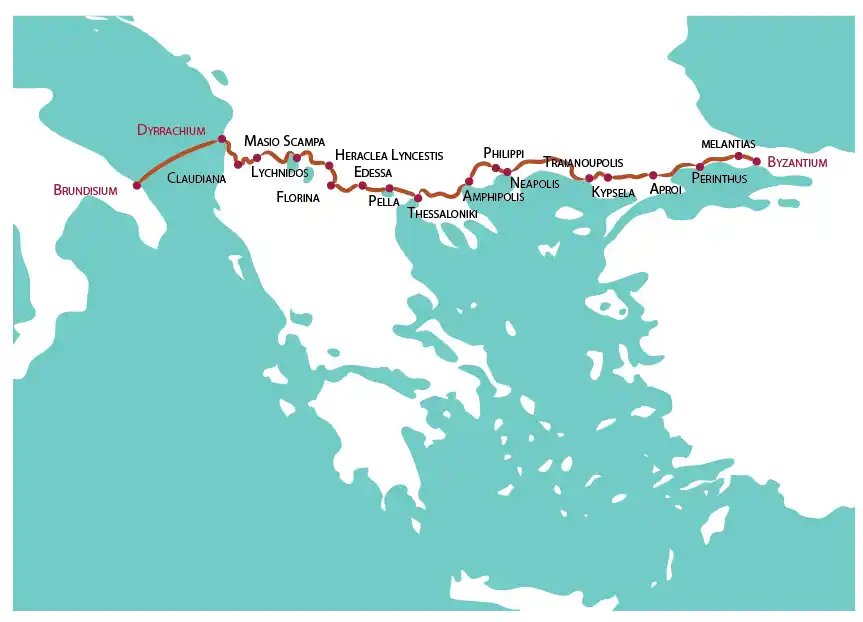
Via Egnatia began at Dyrrachium (now Durrës) on the Adriatic Sea and headed westward along the challenging route following the Genusus River (Shkumbin), crossing the Candaviae Mountains (Jablanica) and continuing around Lake Ohrid. It then curved partially southward before finally reaching the northern Aegean coast at Thessaloniki. From there, it ran through Thrace all the way to Constantinople (modern-day Istanbul). The total distance was approximately 1,120 km (696 miles/746 Roman miles). Like other major Roman roads, it was about six meters wide and paved with large polygonal stone slabs or covered with a hard layer of compacted sand.
The Empire’s Strategic Lifeline
Via Egnatia was built to connect a chain of Roman colonies stretching from the Adriatic Sea to the Bosphorus. Together with the Via Appia, it gave the colonies of the southern Balkans a direct link to Rome and to Roman territories in the east. Bilingual inscriptions on the milestones record that the road’s construction was ordered by Gnaeus Egnatius — the proconsul of Macedonia — which is also where the road gets its name. Historical sources also mention the hypothesis that Via Egnatia replaced an earlier military road running from Illyria to Byzantium.
From the Apostle Paul to the Battle of Durrës
The road was famously used by the Apostle Paul in the first half of the 1st century AD during his second missionary journey to Thessaloniki. It also played a pivotal role in several key moments of Roman history. One notable example is Julius Caesar’s army march in 48 BC, which led to a rather unfriendly encounter with Pompey at the Battle of Dyrrachium (Durrës). It’s worth noting that Caesar actually lost at Durrës — not due to inferior numbers, poor organisation, or a lack of fighting spirit among his soldiers, but because of unfavourable terrain, an unfinished section of fortifications, and the sheer physical exhaustion of his troops. But that’s a story for another time.
Decline, Revival, and the Crusades
By the 5th century AD, however, the road had largely fallen out of use due to growing instability in the region. Simply put, travelling along it was no longer entirely safe. With so little traffic, the western sections of Via Egnatia fell into such disrepair that travellers could barely pass through. In later years, Via Egnatia was revived as a key artery of the Eastern Roman Empire. The long-neglected road had become dilapidated and practically unusable in wet weather, which is why the Eastern Roman Emperor Justinian I had to put it back together in the 6th century. After that, nearly all Byzantine overland trade with Western Europe travelled along Via Egnatia.
The road also saw heavy use during the Crusades, as Christian armies marched along it toward Constantinople and onward into Asia Minor. After the Fourth Crusade, control over the road was vital to the survival of the Latin Empire as well as the Byzantine successor states of the Nicaean Empire and the Despotate of Epirus. Via Egnatia was also frequently used during the early Ottoman Turkish advances into Europe.
History Best Told Over a Glass of Raki
The history of Albanian lands is, to put it simply, remarkably rich and colourful. Albanians know their history well, which means that when serious raki (the beloved local brandy) is being poured, there’s never a shortage of serious topics to discuss — and the stories just keep on coming.