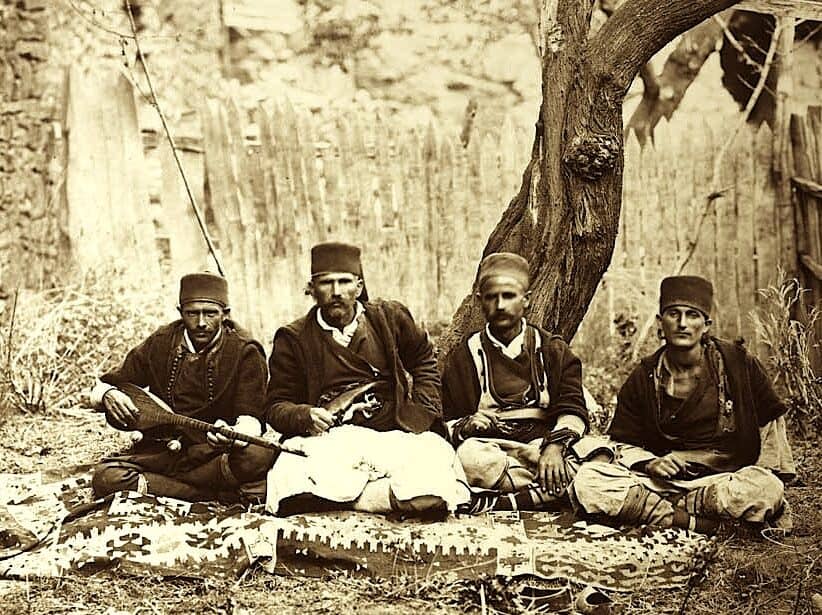
This system was so robust and sophisticated that it managed to survive centuries of Ottoman rule, as the highlanders refused to recognize foreign religious or secular law and preferred to live by their own “laws of the mountains.” The Kanun addressed every aspect of human existence in detail — from property management and land boundaries to the rules of wedding ceremonies and specific obligations during feasts — with its primary goal being the preservation of balance and honour within a clan society where family mattered more than the individual.
Family Honour Above All
The central concept of the entire Kanun is personal and family honour, which in this harsh environment was regarded as the most precious asset — one that cannot be bought, but can be lost with terrifying ease. If a family’s honour was violated, the Kanun saw no solution in forgiveness, but rather in precisely defined compensation, which in the worst cases took the form of blood vengeance, known as gjakmarrja. This mechanism was not an expression of lawlessness or chaos, but rather a very strictly regulated process in which blood could only be cleansed with the blood of an adult male from the perpetrator’s family.
The Rules of the Kanun Were Absolute
At the same time, the Kanun contained a whole range of safeguards designed to prevent the total annihilation of clans. For example, it forbade attacking a man in the company of a woman, in the presence of children, or at a moment when he was under “besa” (a temporary truce). The stone towers known as kulla became the symbol of this era — towers in which men threatened by blood vengeance would hide for decades at a time, while outside, the women tended to the household, as they were considered untouchable under the blood feud.
Hospitality as a Code
A fascinating element of the Kanun is also its view of hospitality, which borders on sacred duty and serves as a counterbalance to its harsher provisions. According to these rules, a host is no longer the owner of his home the moment a guest steps through the door; the house immediately belongs to “God and the guest.” This duty of protection was so powerful that if a guest was attacked after leaving the host’s home, the host was obliged to declare a blood feud against the attacker in order to cleanse his honour — even if he had no personal connection to the guest whatsoever. This absolute commitment to protecting strangers is deeply rooted in the Albanian mentality and explains why, even today, Albanian culture is marked by a seemingly extraordinary level of generosity towards visitors — a generosity that has long since faded from memory in Western Europe.
The Kanun as a Historical Relic?
Although modern Albania strives to distance itself from the legacy of the Kanun and regards it as a relic of the past, its traces remain visible in the country’s social fabric. During the communist regime of Enver Hoxha, the Kanun was banned under penalty of death, and the state came close to eradicating it entirely — but after the regime’s collapse in the 1990s, blood vengeance re-emerged in the north of the country during a period of chaos and weak state authority. It was not until 2008 that the Albanian government outlawed blood vengeance by law.
Today, the Kanun is primarily a subject of anthropological study and literature — such as the works of world-renowned author Ismail Kadare — but the moral imperatives of the Kanun, with its emphasis on keeping one’s word, loyalty to family, and the protection of the vulnerable, remain an integral part of the national character. To truly understand contemporary Albania, it is therefore essential to view the Kanun not as a dead book of laws, but as a cultural code that for centuries has shaped the pride and independence of this Balkan nation.
The Role of Women and the Kanun
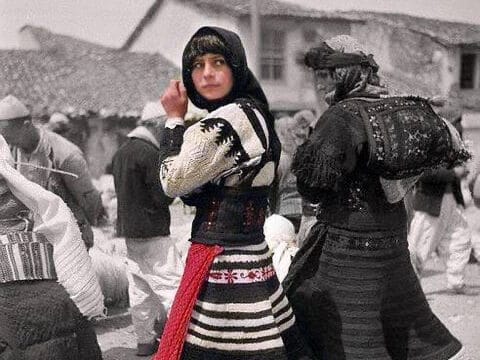
The position of women within the traditional Kanun was, at first glance, highly limited and strictly defined. Women were excluded from inheriting property, could not own land, and had no voting rights at tribal assemblies. Within the blood feud system, they were considered untouchable, as it was believed that their blood did not carry the same “value” as a man’s. Yet this apparent lack of rights paradoxically offered women a certain form of protection in harsh times — a woman could safely pass through the territory of rival clans and carry food to men hiding in defensive towers, without fear of becoming a target. While the Kanun placed women under the authority of their father and later their husband, it simultaneously granted them absolute authority within the household over the upbringing of children and the management of domestic affairs.
There Were Exceptions for Women Too
It was precisely from these rigid rules, and from the need to preserve the family line in situations where a family had lost all its male heirs, that a unique phenomenon was born — the “sworn virgins,” known as burrnesha. The Kanun allowed a woman to voluntarily renounce her female identity, take a vow of celibacy, and assume the role of a man. This act was not motivated by sexual orientation, but by social necessity and the desire to gain freedom. Once a woman had taken this sacred oath before a council of elders, she began dressing as a man, carrying a weapon, drinking alcohol in male company, and — most importantly — could manage the family estate and represent the family in public. From that moment on, society treated her as a man, with all the rights and responsibilities that entailed, including the duty to participate in blood vengeance should the situation demand it.
Burrnesha as a “Legal” Loophole
The phenomenon of burrnesha represented a fascinating “legal loophole” within an otherwise unforgiving Kanun, one that allowed women to escape arranged marriages and gain an independence that was otherwise denied to them. A sworn virgin became the head of the family and was held in enormous respect by the entire community for the sacrifice she had made in order to preserve the name and property of her clan. Although this tradition was a common part of life in the Albanian mountains for centuries, it began to gradually disappear with the modernisation of society and the disintegration of tribal structures. Today, only a few dozen of these women still live in the remote regions of northern Albania — living monuments to an era when a word and an oath held the power to change even one’s very biological identity in the eyes of the law.