Skanderbeg: The Hero Who Lit the Flame of Freedom for Albania, Europe, and the World
Imagine a time when the dark shadow of the Ottoman Empire threatened to swallow not just the Balkans, but all of Europe. And in the midst of it all, a man was born whose name still sends shivers down your spine and stirs a sense of pride – Gjergj Kastrioti, known as Skanderbeg. This unbreakable warrior is not merely an Albanian national hero – he remains a universal symbol of unwavering struggle for freedom, regardless of region. His brave and ingenious stand against the overwhelming Turkish forces continues to serve as compelling testimony that true strength lies in cleverness, perseverance, and conviction, rather than in cheap and short-sighted pursuit of immediate victory.
Unifier of a Nation and Architect of Religious Tolerance
In 1444, at a time when Albanian tribes were divided and weakened, he convened the League of Lezhë – a kind of medieval alliance reminiscent of today’s NATO. With a small army, often just a few thousand men, he stood against enormous Ottoman hordes of up to 300,000 soldiers under Sultan Mehmed II, the conqueror of Constantinople. How did he manage it? Through brilliant guerrilla tactics, knowledge of the mountains, and above all, through alliances. He showed the world that only the unification of forces can defeat even a far more numerous enemy. His policy of religious tolerance, where believers of different faiths fought side by side, laid the foundations of modern Albanian consciousness. And what of Europe? Skanderbeg’s resistance gave the continent precious time for the Renaissance, for the discovery of new worlds, and for strengthening unity against a common threat. He was supported by Pope Calixtus III and also by Pius II, who however died in 1464 at the very moment when troops were beginning to gather to support Skanderbeg’s fight against the Turks. His death marked the effective end of the entire crusade, and Skanderbeg was left to fight Sultan Mehmed II almost alone. He gazed in vain from the port of Durrës, watching for Italian ships that never came.
Where Did He Come From?
He was born in 1405 and as a teenager was taken from his father by the Ottomans, along with his brothers, to the Ottoman court. He was extraordinarily capable and demonstrated remarkable abilities not only in general education, but also in military strategy. The Sultan gave him the title “Iskander Bey” – Lord Alexander – and showered him with offers of wealth and social standing. Nevertheless, in 1443, during the Battle of Niš, the flame of love for his homeland that he had secretly kept alive throughout his years at the Turkish court ignited in his heart. He defected, returned to Albania, and declared a rebellion. He rejected the Sultan’s gifts, choosing to go hungry in the mountains with his people rather than betray his nation. His 25 years of fighting and victories – such as the siege of Krujë in 1450 or the Battle of Albulena in 1457, where he defeated 80,000 Ottomans with just 10,000 men – elevated his political and military power to its peak. While other Balkan rulers gradually became Turkish vassals, he sacrificed his life and the fortunes of his descendants for his country and for the idea of a strong state. This conviction, stronger than any gold, inspired the Albanian national renaissance and continues to show the world that perseverance and belief can overcome even the greatest temptation.
Skanderbeg in the Modern Age: From Statues to Political Speeches and Contemporary Challenges
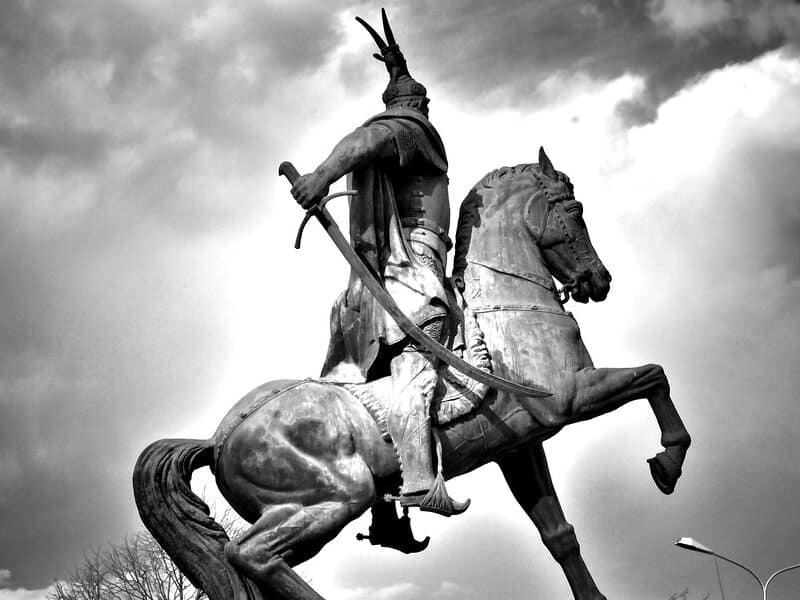
Today, in 2026, as the world grapples with new challenges tied to globalisation and the conflicts it brings, Skanderbeg feels more alive than ever. In the political speeches of many leaders, he serves as a moral beacon and a cornerstone of calls for national cohesion and independence. His name strengthens Albanian identity and supports a policy of national and cultural continuity. You see him everywhere – a statue on Skanderbeg Square in Tirana, universities, institutions, and state honours bearing his name. But his influence reaches further still – Voltaire celebrated him as a defender of civilisation, Lord Byron honoured him in poetry, and in America his statue stands in Washington as a symbol of the struggle for freedom. For the entire world, he is an example of how alliances – not only between tribes, but between nations – defeat tyrants. In the context of today’s crises, from Ukraine to the Middle East, he reminds us: “Do not be tempted by the cheap illusion of short-term prosperity at the cost of being unable to resist tyrants!”
A Living Symbol of National Identity
His legacy is not merely a historical myth – it is a source of inspiration for today’s challenges, whether domestic or international. To lose this myth would mean impoverishing Albania’s collective soul, weakening the strength of community throughout history, and surrendering the kind of historical greatness that once sparked humanism and the Renaissance. The myth of Gjergj Kastrioti Skanderbeg is a living force that shapes contemporary life, politics, culture, civilisation, and ethics – not only for the Albanian people, but for countless people around the world. It is a call to us all: “Unite, persevere – and freedom will prevail!” It is remarkable, then, that his voice, and the voices of figures like him, are being drowned out in a flood of hollow, cheap, and populist promises from politicians who think first and foremost of themselves rather than of their nation. Who knows what Western Europe would look like today had there been no figures like Skanderbeg? And equally, who knows what Europe might look like today if there were enough “Skanderbegs” among us still.