Why Do the Locals Call Themselves “Children of the Eagles”?
Albanians have Paleo-Balkan origins, attributed to the Illyrians, Thracians, or other Paleo-Balkan peoples — a topic still debated among historians and ethnologists. The first direct mention of the ethnonym Albanon or Arbanon appeared in the 2nd century AD, when Ptolemy described an Illyrian tribe living in what is now central Albania, in a settlement located to the northeast of present-day Durrës. This Illyrian tribe gave its name to modern-day Albania — but only for the rest of the world. Within Albania itself, the name Shqipëria prevails, derived from a verb meaning “to speak” or “to speak clearly and intelligibly.” During the Middle Ages, Albania was known as Arbëri or Arbëni, and its inhabitants were called Arbëreshë or Arbëneshë. Both of these terms are generally interpreted as meaning “Children of the Eagles” or “Land of the Eagles.”
Gheg and Tosk: How Politics United a Language
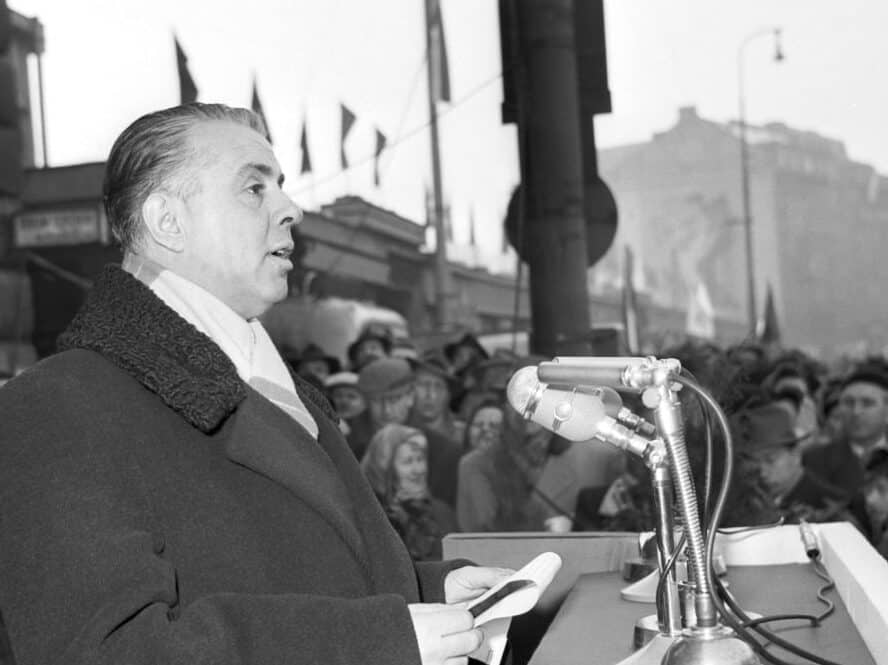
Albanian has two main dialects — Gheg (northern Albania) and Tosk (southern Albania). These two zones are separated by the Shkumbin River, which flows through the center of Albania. Neither dialect previously held the status of the official Albanian language. In the post-war period, politicians from southern Albania played a dominant role in the Communist Party — and consequently in the state apparatus — which ultimately led in 1972 to the unification of standard Albanian on a southern Tosk basis with Gheg elements. Pure Gheg thus fell into decline in both political and literary life. However, following the collapse of the communist regime, literary creativity in the Gheg dialect experienced a revival.
Where Did Albanian Come From?
Albanian is a language that proudly walks its own path — ancient and truly unique. Within the world’s most widespread language family — the Indo-European — it is something of a solo act. Albanian has a unique grammar and vocabulary that sets it apart from all other languages in the Indo-European family. The Albanian alphabet contains 36 characters. Among all the world’s languages, Khmer holds the record with 74 characters. Within the Indo-European languages, Albanian maintains its status as a “soloist” — it doesn’t belong to any well-known subgroup such as the Slavic, Romance, or Germanic languages.
The term “Indo-European languages” was coined in 1813 by British physicist and physician Thomas Young — incidentally, a man who spoke thirteen languages by the age of fourteen. Based on combined linguistic and genetic analyses, it is believed that the Indo-European language family began to emerge approximately 8,000 years ago south of the Caucasus. Scholars consider Albanian to be a descendant of the language of the ancient Illyrians — a people who inhabited the western Balkans. Despite having such deep roots, the first written records of Albanian don’t appear until the 16th century.
Albanian’s Footprint in the World: Where Is Albanian Spoken?
Albanian is spoken in Albania, Kosovo, and North Macedonia, but also in other areas of southeastern Europe with Albanian populations, including Montenegro and the Presheva Valley. Albanian is even an official language of Kosovo, a co-official language of North Macedonia, and one of the official languages of Montenegro. Century-old communities speaking Albanian dialects can be found scattered across Croatia, the regions of Western Macedonia and Western Thrace, Italy, and also in Romania and Ukraine. Albanian diaspora communities are spread across many countries throughout the world.
In the United States and Canada, there are approximately 250,000 Albanian-speaking residents. In Argentina, primarily in Buenos Aires, there are nearly 40,000 Albanian speakers. Approximately 5–7 million people of Albanian origin live in Turkey, of whom more than 500,000 are aware of their heritage, language, and culture. However, some estimates place the number of people of Albanian origin in Turkey at 10–12 million. The vast majority of this population has assimilated and no longer speaks the language fluently, although a vibrant Albanian community in Istanbul continues to maintain its distinct identity to this day.
Due to historical ties, approximately 18,000 Albanians live in Egypt. Many of them are descendants of Muhammad Ali Pasha, an Albanian who became the self-proclaimed governor of Egypt and Sudan in the 19th century. Albanian is also spoken by Albanian communities in Australia and New Zealand.